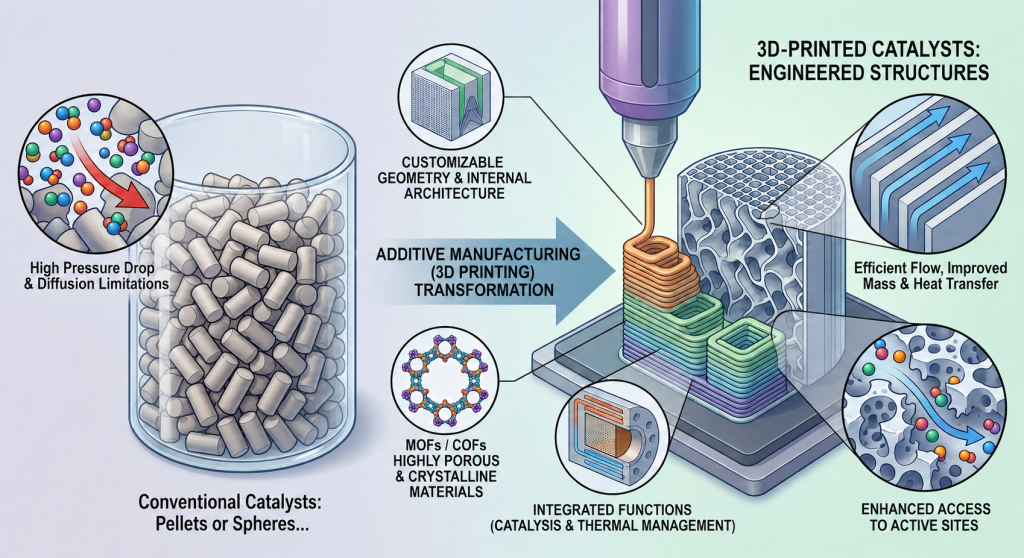
3D printing is becoming a key technology in the development of catalysts, as it enables precise control over geometry and internal architecture. This approach is redefining catalytic design, moving from conventional materials to optimized functional structures.
Thanks to additive manufacturing, it is possible to create highly porous catalysts (e.g., MOFs, MOPs, COFs, etc.) with well-defined channels that improve diffusion, enhance access to active sites, and reduce pressure drop. In addition, it allows optimization of mass and heat transfer through hierarchical architectures and more efficient flow distributions, which is critical in industrial processes.
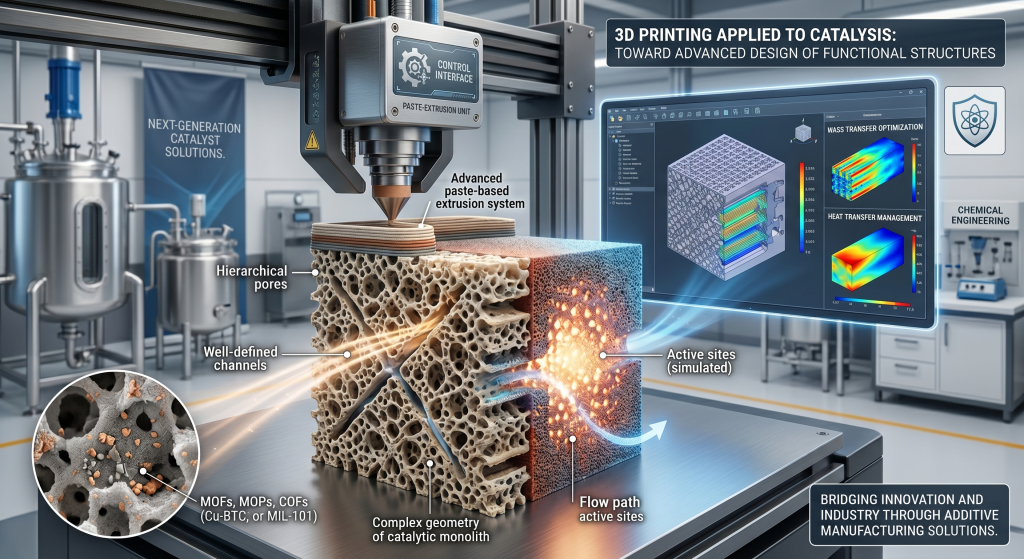
3D printing also facilitates the customization of catalytic supports and the integration of multiple functions into a single structure—such as catalysis and thermal management—simplifying reactor design. It also enables rapid prototyping, accelerating the development and validation of new designs.
Although challenges still remain, its combination with artificial intelligence, advanced materials, and hybrid processes points to strong growth potential.
Overall, 3D printing is driving a paradigm shift in chemical engineering, enabling the design of tailor-made catalysts that significantly improve process efficiency.
At MERYT Catalysts & Innovation, we are interested in the use of 3D printing in catalysis to bridge the gap between innovative design and industrial application.
Our goal is to transform catalyst design, moving from conventional materials to high-performance structures tailored for real processes. As industries move toward greater efficiency, flexibility, and sustainability, the way catalysts are designed and manufactured must evolve.
3D printing offers a powerful platform to achieve this transformation, enabling precise structural control, improved mass and heat transfer, and the integration of multiple functionalities into a single device.