
At MERYT Catalysis & Innovation, we continuously monitor the global landscape for breakthroughs that push the boundaries of catalytic technology and materials science. This week, we are highlighting an extraordinary piece of research published in Nano Research that offers a next-generation solution for environmental decontamination.
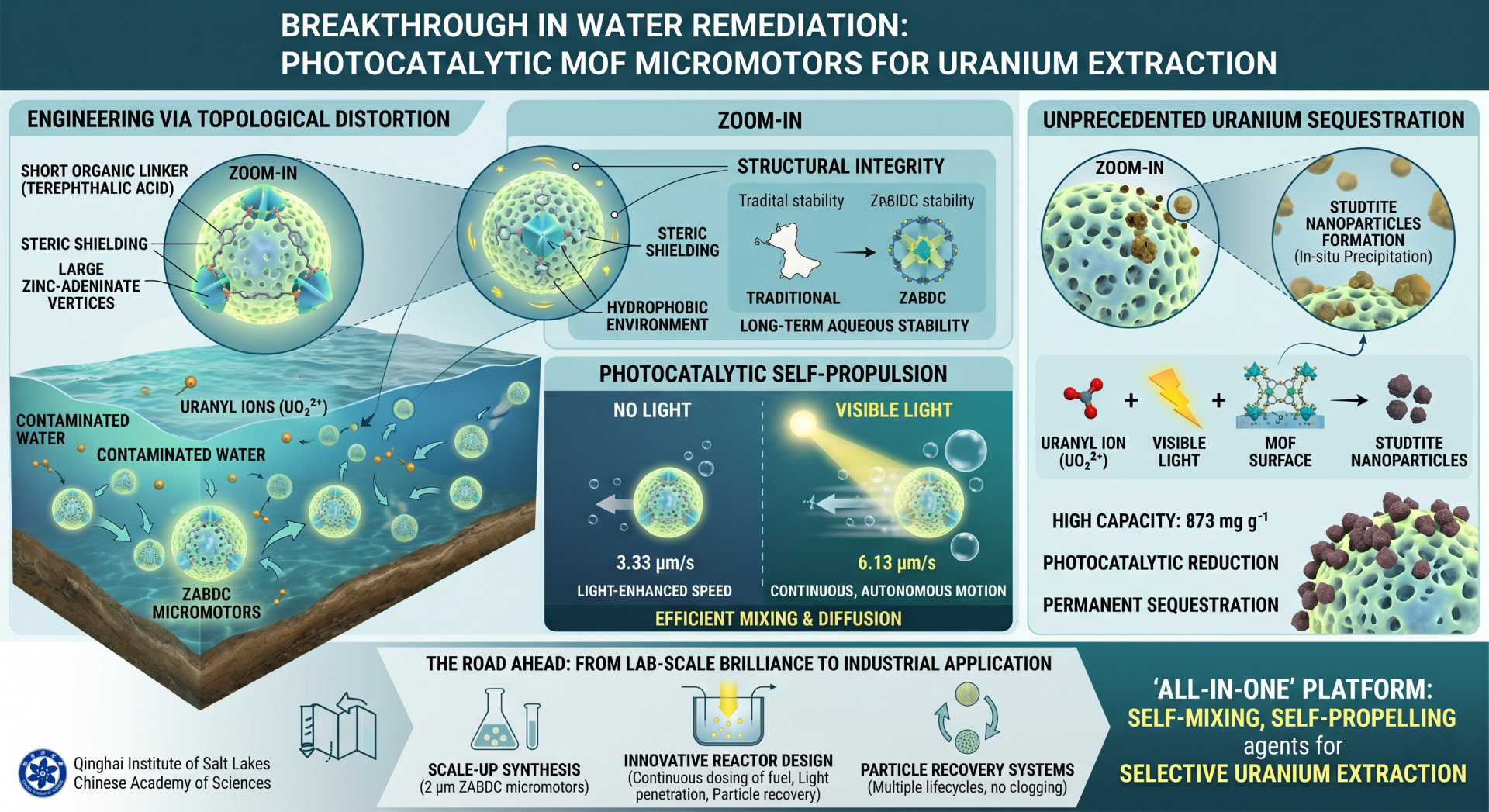
The study, led by researchers from the Qinghai Institute of Salt Lakes (Chinese Academy of Sciences), introduces highly stable spherical metal-organic framework (MOF) micromotors specifically engineered for the photocatalytic extraction of uranium from wastewater.

Metal-organic frameworks are highly desirable porous adsorbents known for their exceptional capacity to capture heavy metals and radionuclides. However, their practical application in water treatment is frequently hindered by hydrolytic instability; complex, elongated linkers often lead to the breakdown of the framework in aqueous environments. Furthermore, maximizing adsorption kinetics typically requires vigorous external mechanical stirring, which increases operational costs.
To overcome these barriers, the research team developed a novel fluorescent Zn-adeninate-based micromotor (ZABDC). They employed a heuristic design strategy involving “topological distortion”.
These ZABDC micromotors do not just sit in the water; they are active matter.
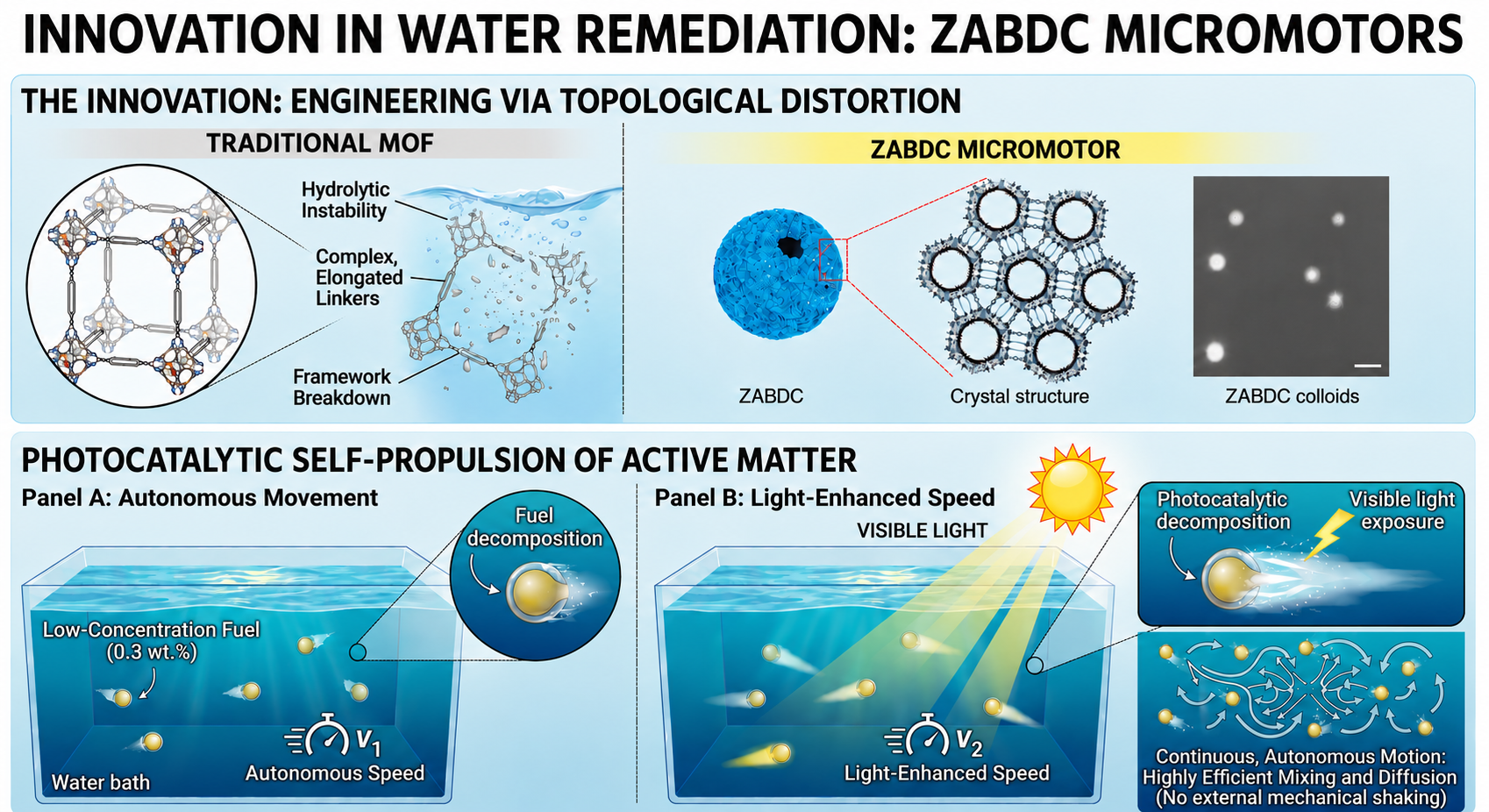
The continuous motion combined with a highly porous structure rich in nitrogen and oxygen chelating sites yields spectacular results for water purification.
This “All-in-One” platform represents a significant leap forward. By merging the autonomous navigation of micro-robotics with advanced photocatalytic remediation, industries could soon deploy self-mixing, self-propelling catalytic agents capable of selectively extracting valuable or toxic radionuclides from complex water matrices.
Read the full scientific article here: