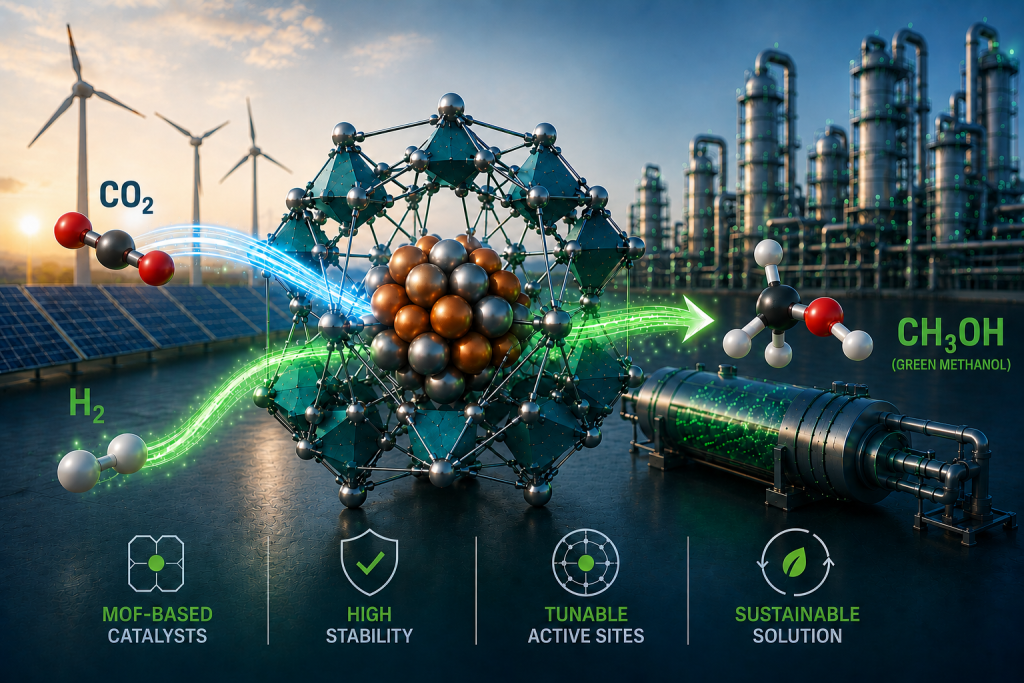
The large-scale production of green methanol (CH3OH) obtained from CO2 and green H2 is a highly desired process. Methanol acts not only as a clean fuel but also as a hydrogen/energy carrier and a raw material for producing a wide range of chemicals.
Although the ternary Cu/ZnO/Al2O3 catalyst is industrially employed as a benchmark for selective CO2 hydrogenation, its catalytic activity is still not fully satisfactory due to deactivation, and the true nature of its active sites remains unclear. This is where Metal-Organic Frameworks (MOFs) come into play, offering unprecedented nanoscale customization and a large density of active sites.
One of the main obvious reasons limiting the use of MOFs as gas-phase catalysts is their lack of thermal stability. Most frequently, organic ligands undergo structural collapse at temperatures around 250 °C. However, CO2 hydrogenation to CH3OH is typically carried out at temperatures between 250 and 300 °C to overcome kinetic energy barriers and achieve measurable reaction rates.
Fortunately, there is a temperature compatibility window. Highly robust structures, such as the zirconium-based UiO-66, have proven capable of withstanding temperatures up to 400 °C without undergoing structural collapse, making them highly promising candidates for this reaction.

Current research highlights how the flexibility in the design and synthesis of MOFs can be used to enhance catalytic activity. The main pathways for innovation include:
Used as hosts to encapsulate metal nanoparticles, stabilizing them and preventing their agglomeration.
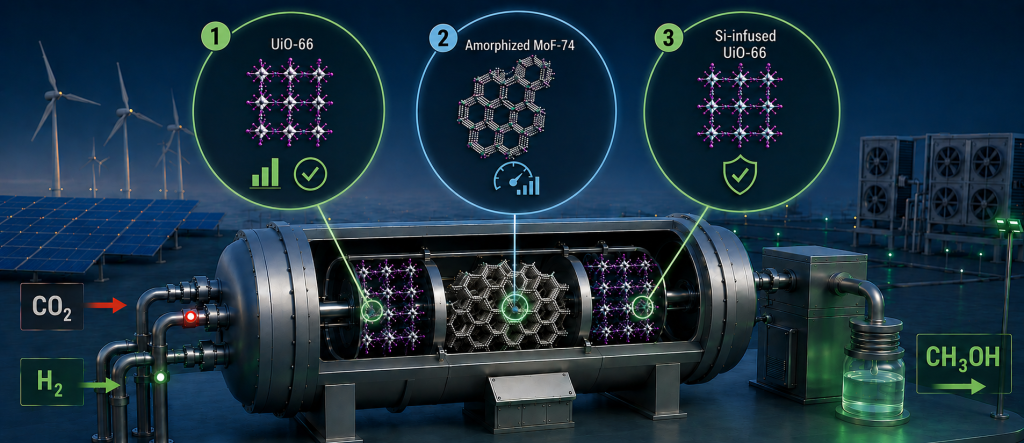
The amorphization or presence of defective sites act as highly efficient catalytic centers, reducing competitive reactions.
Combining metals at the nodes facilitates synergistic catalysis; Zn2+ is primarily responsible for H2 activation, while the Zr4+ site favors the adsorption and conversion of CO2.
To illustrate the impact of these innovations, here is a summary of some of the most successful strategies applied to different MOF systems and their respective observed benefits:
ZnCu-MOF-74
Increases methanol productivity by 4-7 fold compared to its crystalline precursor.
s-UiO-66 (Si-infused)
Provides a robust structure at reaction temperatures, preventing the agglomeration of CuO nanoparticles.
Cu embedded in UiO-66
Solving the issue of structural stability under industrial operating conditions (temperature, pressure, and the presence of water) is the key issue to solve in this area. If this is achieved, the large versatility of MOFs in designing active sites at the atomic scale will make them unbeatable catalysts. At MERYT Catalysts & Innovation, we are closely following these scientific breakthroughs that pave the way for a truly decarbonized and efficient chemical industry.