
Metal-Organic Framework (MOF)-based membranes have attracted tremendous interest in the field of water treatment for years. Their highly porous and well-ordered structure enables extremely precise molecular separation, making them ideal candidates for removing complex contaminants. However, one major challenge has limited their industrial adoption: stability.
Layered MOF membranes consist of stacked nanosheets held together primarily by weak intermolecular forces. During continuous operation in aqueous environments, these layers can swell, become disordered, or even collapse, rapidly reducing membrane performance.
A recent study published in Advanced Functional Materials presents an elegant solution to this challenge through a strategy known as Molecular Stitching, which reinforces the membrane structure without compromising its separation performance.
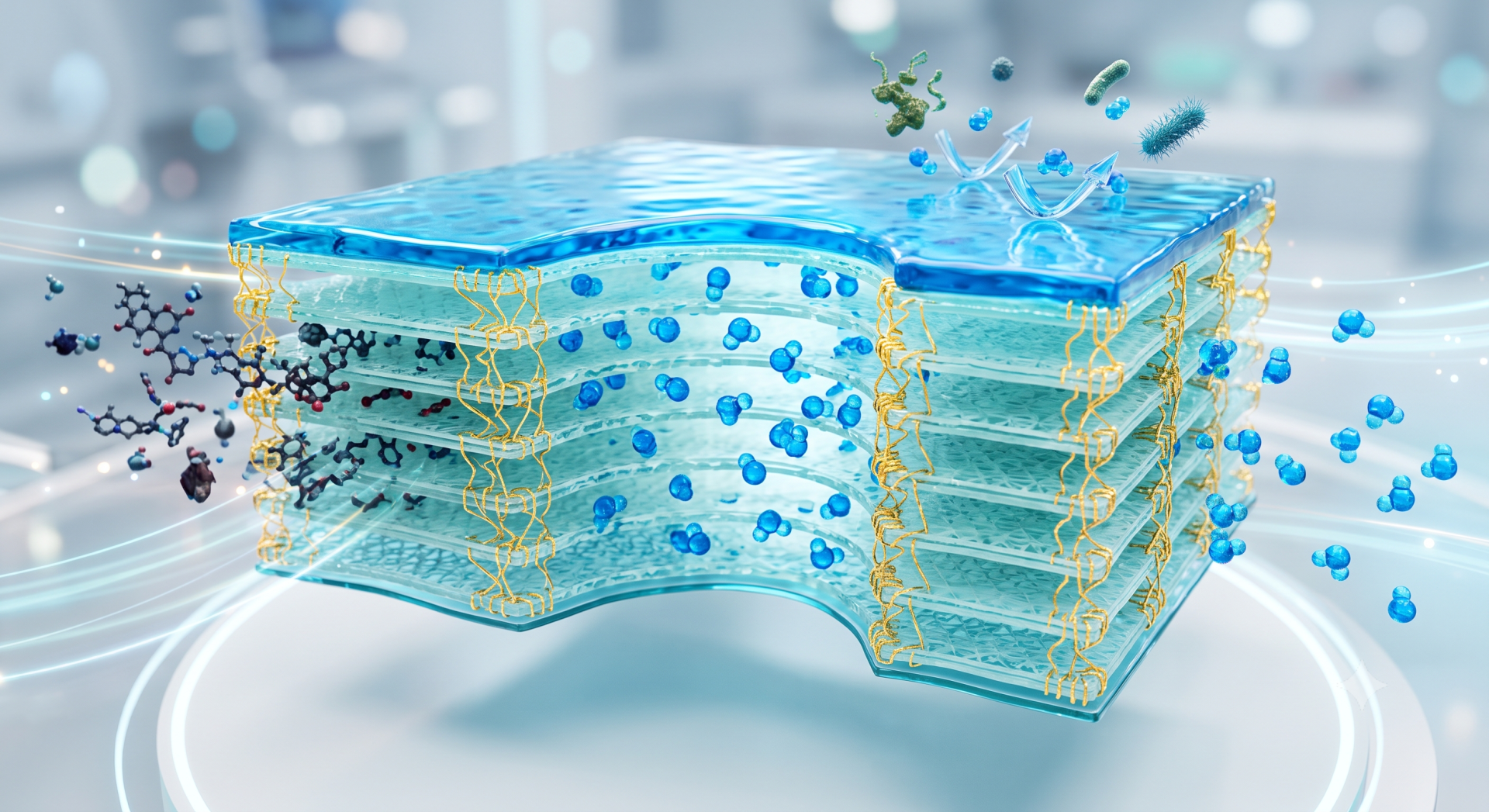

The concept can be understood through a simple analogy. Imagine a stack of extremely thin sheets of paper. If they are simply placed on top of one another, the structure is unstable and easily disturbed. However, if the sheets are joined together with small stitches strategically placed along their edges, the entire structure becomes much stronger without blocking the space between the sheets.
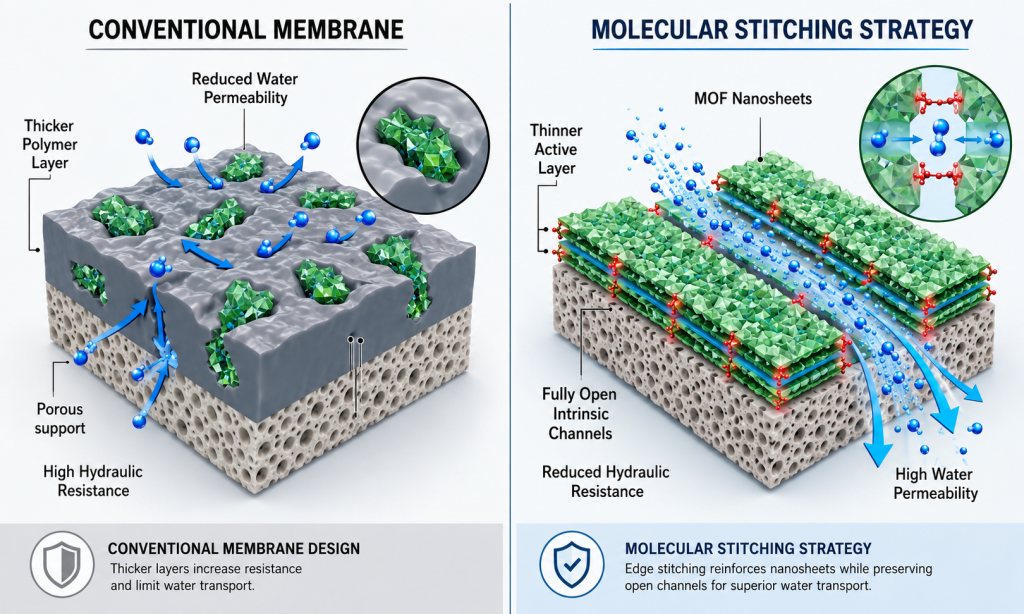
This is precisely what Molecular Stitching achieves. During membrane fabrication, researchers carry out a controlled interfacial polymerization process that forms tiny polyamide nanodomains exclusively along the edges of the MOF nanosheets.
These nanostructures act as molecular stitches, firmly connecting adjacent layers while leaving their intrinsic pores completely open. The result is a significantly more robust membrane that preserves virtually all its transport capacity.
In conventional membranes, improving mechanical strength typically requires adding thicker polymer layers. The drawback is straightforward: the more polymer is added, the greater the resistance to water transport.
The Molecular Stitching strategy avoids this trade-off.
By reinforcing only the edges of the nanosheets:
One of the most significant aspects of the study is its application to the removal of PFAS (per- and polyfluoroalkyl substances), commonly referred to as “forever chemicals” because of their exceptional persistence in the environment.
These contaminants are particularly difficult to remove using conventional treatment technologies.
This outstanding performance results from several complementary mechanisms acting simultaneously:
Narrower and more uniform transport channels.
More precise molecular sieving.
Electrostatic repulsion of charged contaminants.
A stable hydration layer that suppresses PFAS adsorption.
One of the highest operating costs in membrane systems is membrane fouling. The accumulation of organic matter and microorganisms progressively reduces water flux, increases energy consumption, and requires frequent cleaning.
The surface produced through Molecular Stitching combines hydrophilic and hydrophobic regions that stabilize a robust layer of water molecules across the membrane surface. This hydration layer acts as an energetic barrier, making it much more difficult for proteins, organic matter, and bacteria to adhere to the membrane.
As a result, cleaning becomes much easier and after a simple hydraulic rinse with water, the membrane recovered up to 96% of its original water flux, considerably outperforming comparable membrane technologies.
The evaluation extended well beyond laboratory-scale experiments. Researchers tested the membrane during 30 days of continuous river water filtration, obtaining particularly promising results.
In addition:
These findings indicate that technology now offers not only excellent separation performance but also the long-term durability required for industrial applications.
For years, MOF membranes have demonstrated enormous potential, yet their limited structural stability has hindered practical implementation. Molecular Stitching shows that this challenge can be overcome through a relatively simple strategy that combines materials engineering, polymer chemistry, and interfacial design.
This approach is likely to play a key role in the next generation of nanofiltration technologies for drinking water production, water reuse, and the removal of emerging contaminants.
At MERYT Catalysts & Innovation, we closely follow these developments because they represent the future direction of advanced materials for separation and purification technologies. The combination of MOF structures, functional polymers, and innovative interfacial architecture opens new opportunities to develop more efficient, sustainable, and application-specific solutions for the challenges of tomorrow.