What if the future of sustainable methanol production depended not on discovering new catalyst materials, but on engineering them atom by atom?
Methanol (CH3OH) is far more than a cleaner fuel. It is one of the most important building blocks of the chemical industry, used to manufacture products ranging from formaldehyde and acetic acid to plastics and synthetic fibres. Producing methanol from captured CO2 and renewable hydrogen offers an attractive route to recycle carbon emissions while supporting the transition toward a circular carbon economy.
However, turning this concept into an industrial reality remains a massive chemical engineering challenge. Conventional oxide-based catalysts, such as the industry-standard Cu/ZnO/Al2O3, must withstand demanding operating conditions, typically involving elevated temperatures (250 – 400 ºC) and intense pressures of 60–100 bar. Under these harsh conditions, metal nanoparticles inevitably tend to sinter, the active surface area severely decreases, and catalyst performance gradually declines due to impurity accumulation. Furthermore, controlling the reaction pathways—specifically suppressing the competing reverse water-gas shift (RWGS) reaction to favor direct CO2 hydrogenation—requires a level of active-site precision that traditional supports simply cannot maintain.
A recent publication in Chemistry – A European Journal by researchers from KAUST (King Abdullah University of Science and Technology) suggests that the next breakthrough may not come from discovering entirely new catalytic materials, but from engineering the interface between the active metal and its support.
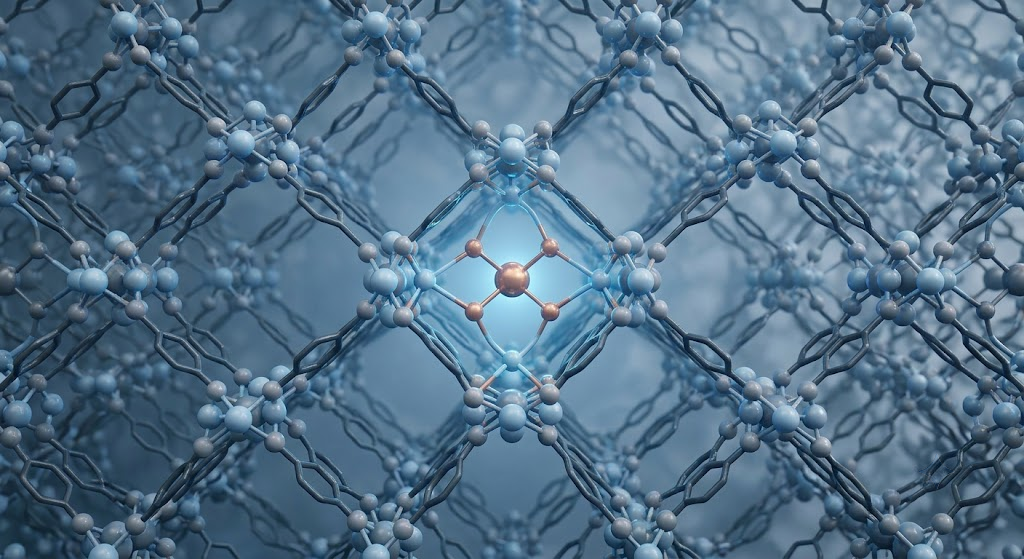
Metal–Organic Frameworks (MOFs) have emerged as ideal platforms for this purpose. Their high surface area, tunable pore structure, and well-defined architecture allow researchers to precisely control metal dispersion and tailor the local chemical environment of active sites. Instead of acting as passive supports, MOFs become active partners in catalyst design, helping to improve activity, stability, and methanol selectivity.
Missing linkers act as anchoring sites for sub-nanometric copper clusters, preventing nanoparticle aggregation while maintaining excellent structural stability. Delivers methanol selectivities above 90%.
Isolated copper atoms are stabilized inside the MOF-808 structure through electrostatic interactions. Prevents clustering and tailors electronic properties. Selectivities around 93%.