Spray Drying: From MOF Synthesis to Industrial Scale-Up
Metal–organic frameworks (MOFs) and covalent organic frameworks (COFs) have attracted significant interest due to their exceptional porosity and their potential in applications ranging from gas storage and CO₂ capture to gas separation and catalysis. However, translating these materials from laboratory research to industrial applications requires not only high-performing materials, but also manufacturing processes capable of producing them continuously, reproducibly, and at scale.
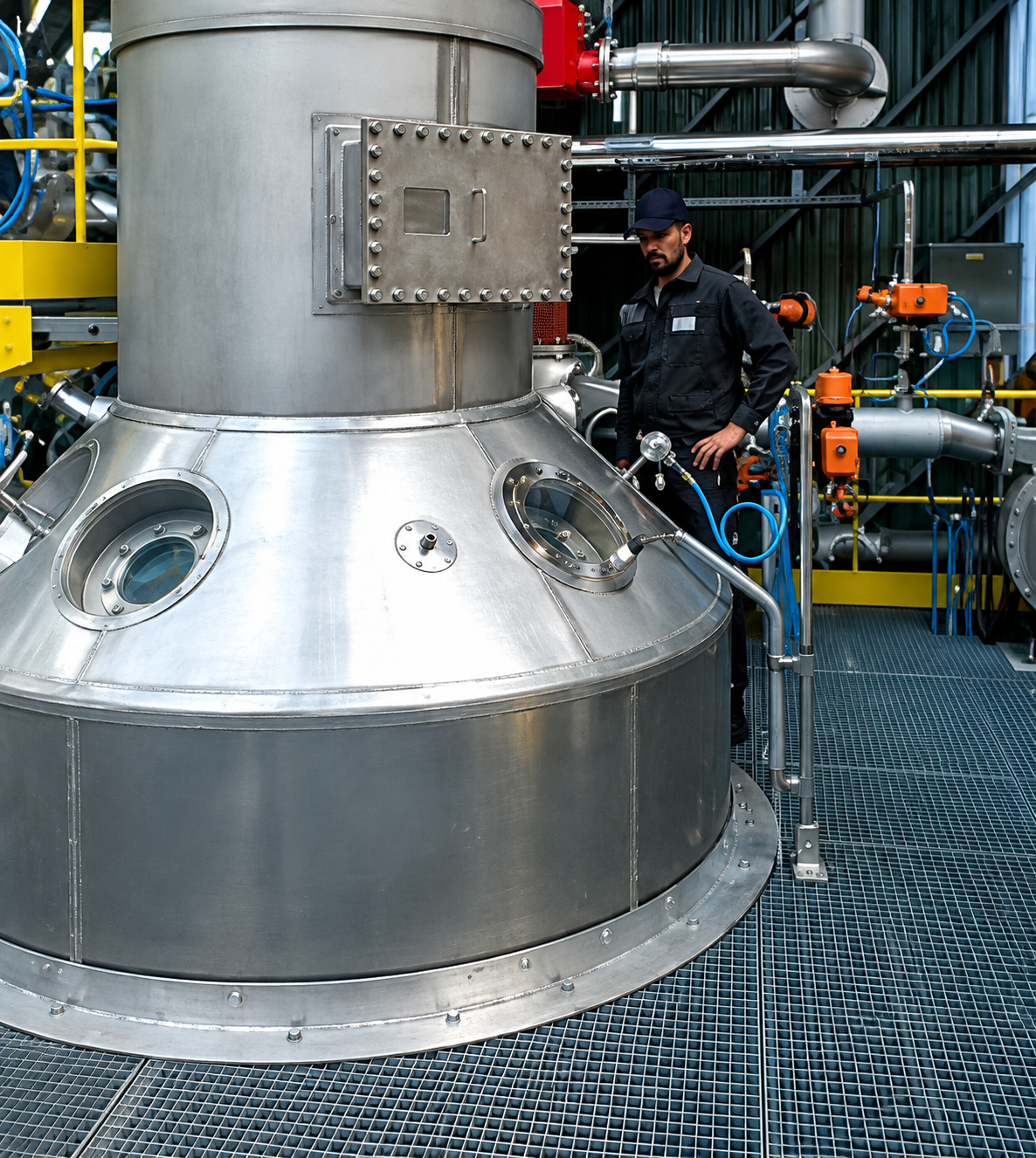
In this context, spray drying emerges as a particularly promising platform for the synthesis and shaping of porous materials. Unlike conventional batch approaches, spray drying can transform precursor solutions into dry microspherical powders through a rapid, continuous process. The technique is already well established in industrial sectors such as food and pharmaceuticals, providing an existing technological basis for its adaptation to advanced materials manufacturing.
More Than Drying: A Process for Controlling MOF Formation
The principle of spray drying is based on atomizing a precursor solution into small droplets that are subsequently exposed to a hot gas stream. The resulting droplets behave as confined reaction environments in which solvent evaporation, nucleation, crystallization, and particle formation can take place.
This is particularly relevant for MOFs because the conditions during atomization and drying directly influence the morphology and properties of the final material. Feed rate, atomizing gas flow, inlet temperature, and, when required, the temperature of a continuous-flow reactor upstream of the dryer must be carefully balanced. Increasing production rate, for example, can also increase the energy requirements associated with atomization and drying.
The study by Troyano et al. demonstrates that different reaction kinetics require different process configurations.
For MOFs with fast crystallization kinetics, T-junctions or three-fluid nozzles can minimize the contact time between reactive precursors before atomization. This approach was successfully applied to materials including ZIF-8, MOF-5 and IRMOF-3, helping to avoid premature precipitation and nozzle blockage.
For MOFs with slower crystallization kinetics, such as zirconium-based UiO-66 materials, a continuous-flow reactor can be coupled directly to the spray dryer. This allows precursor solutions to undergo controlled thermal activation and nucleation before atomization, producing compact spherical MOF beads rather than the hollow structures typically obtained through direct injection. UiO-66 and several derivatives were successfully synthesized using this strategy.
This demonstrates an important principle for scale-up: spray drying is not simply a downstream drying operation; the reactor configuration and process parameters can be used as tools to control MOF formation and particle architecture.
Towards Greener MOF Manufacturing
One of the key challenges in translating MOF synthesis to industry is the use of organic solvents. The study therefore explored aqueous spray-drying routes for zirconium-based MOFs.
UiO-66-NH₂ and Zr-fumarate (MOF-801) were produced using water and acetic acid through a continuous-flow-assisted spray-drying process. By controlling the concentration of the modulating agent, the researchers obtained spherical UiO-66-NH₂ beads with a BET surface area of 1270 m²/g, produced at a 40 g scale with an 85% yield.
These results demonstrate the potential of combining continuous processing, aqueous synthesis, and particle shaping in a single manufacturing platform.
Importantly, the authors do not present spray drying as a universally solved green technology. They conclude that further work is still required to make these processes greener, safer, cheaper, and more suitable for pilot-scale production.
From MOFs to Functional Composites
The versatility of spray drying extends beyond the synthesis of pure MOFs and COFs. Additional functional materials can be incorporated directly into the precursor feed, enabling the production of composites in a single step.
The study reports the incorporation of inorganic nanoparticles such as Pd, Pt, Au, CeO₂, and Au/CeO₂ into UiO-66-type beads. Among these materials, an Au/CeO₂@UiO-66 composite achieved complete CO conversion at temperatures as low as 100 °C, demonstrating the potential of spray drying to combine MOF architectures with active catalytic components.
Other examples include salt@MOF, MOF@polymer, MOF@COF, and nanoparticle@COF systems.
In these cases, spray drying provides an additional advantage: the composition of the final composite can be controlled through the composition of the initial feed, while the material can be obtained directly in its dry, structured form.
The Step Towards Industrial Production
What This Means for the Future of MOFs
At the same time, the study highlights that scale-up is fundamentally a process-engineering challenge. Feed composition, reaction kinetics, residence time, atomization, temperature, energy consumption, solvent management, and particle morphology must all be considered together.
For companies working to bring MOF-based technologies from the laboratory to industrial applications, this is a critical insight: high-performance MOFs are only part of the equation. Their industrial value also depends on whether they can be synthesized, shaped, and processed reproducibly at the required scale.
MERYT’s Vision
At MERYT Catalysts & Innovation, this perspective reinforces the importance of connecting advanced materials development with process engineering and industrial scale-up. The future of MOF-based technologies will depend not only on discovering new structures, but also on developing robust manufacturing strategies capable of translating their performance into real-world applications.