
Nobel Prize in Chemistry 2026: When Chemistry Learns to Choose a Mirror Image

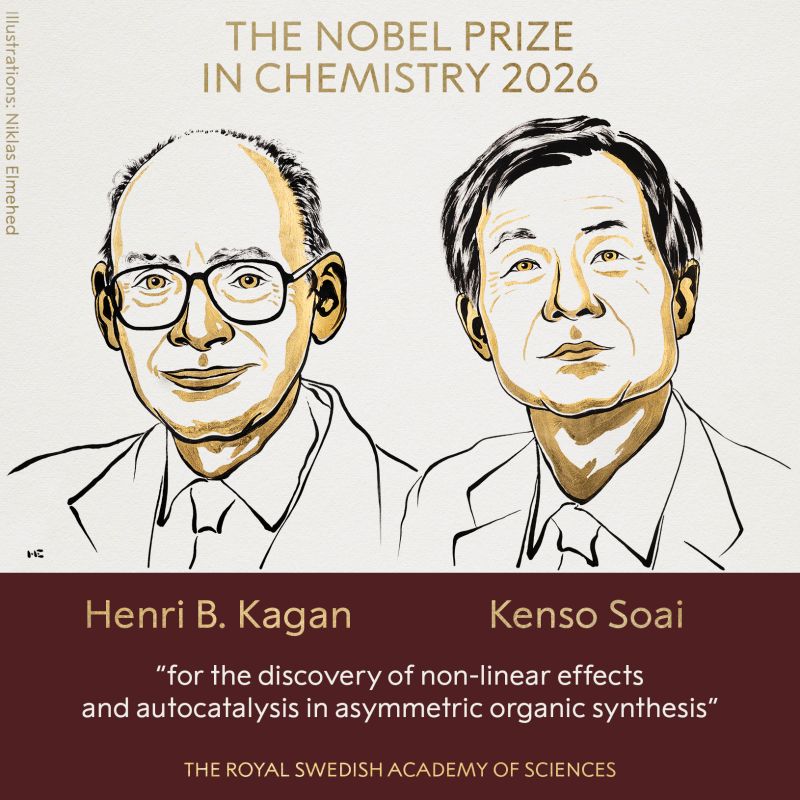
Henri B. Kagan and Kenso Soai have been awarded the 2026 Nobel Prize in Chemistry for their discoveries concerning nonlinear effects and autocatalysis in asymmetric organic synthesis. Their work has provided a deeper understanding of how molecular asymmetry can emerge and be amplified one of the major questions in chemistry.

Figure 1. Nobel Prize in Chemistry 2026. © Johan Jarnestad/The Royal Swedish Academy of Sciences

In chemistry, small structural differences can have enormous consequences. Two molecules can be made up of exactly the same atoms and have almost identical structures, yet differ in one fundamental aspect: one can be the mirror image of the other.

This property, known as chirality, is essential to understanding the chemistry of living organisms and is also highly important in the development of pharmaceuticals, agrochemicals, flavors, fragrances, and new materials.

For their contributions to understanding and controlling this molecular asymmetry, Henri B. Kagan and Kenso Soai have been awarded the 2026 Nobel Prize in Chemistry by the Royal Swedish Academy of Sciences. Their work focuses on nonlinear effects and autocatalysis in asymmetric organic synthesis.

A Historical Curiosity: 200 Nobel Laureates in Chemistry

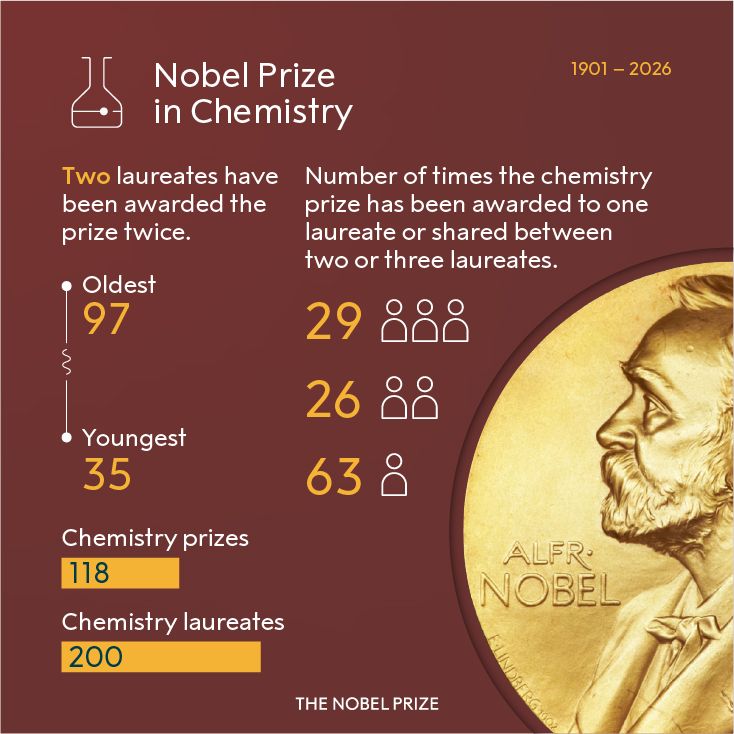
The 2026 Nobel Prize in Chemistry also brings a historical curiosity. With the addition of Henri B. Kagan and Kenso Soai, the total number of people awarded the Nobel Prize in Chemistry has reached 200 laureates since the prize was established in 1901. In total, 118 Nobel Prizes in Chemistry have been awarded.

Figure 2. Milestone in the history of the Nobel Prize in Chemistry. © Johan Jarnestad/The Royal Swedish Academy of Sciences

The Chemistry of Molecules “in the Mirror”

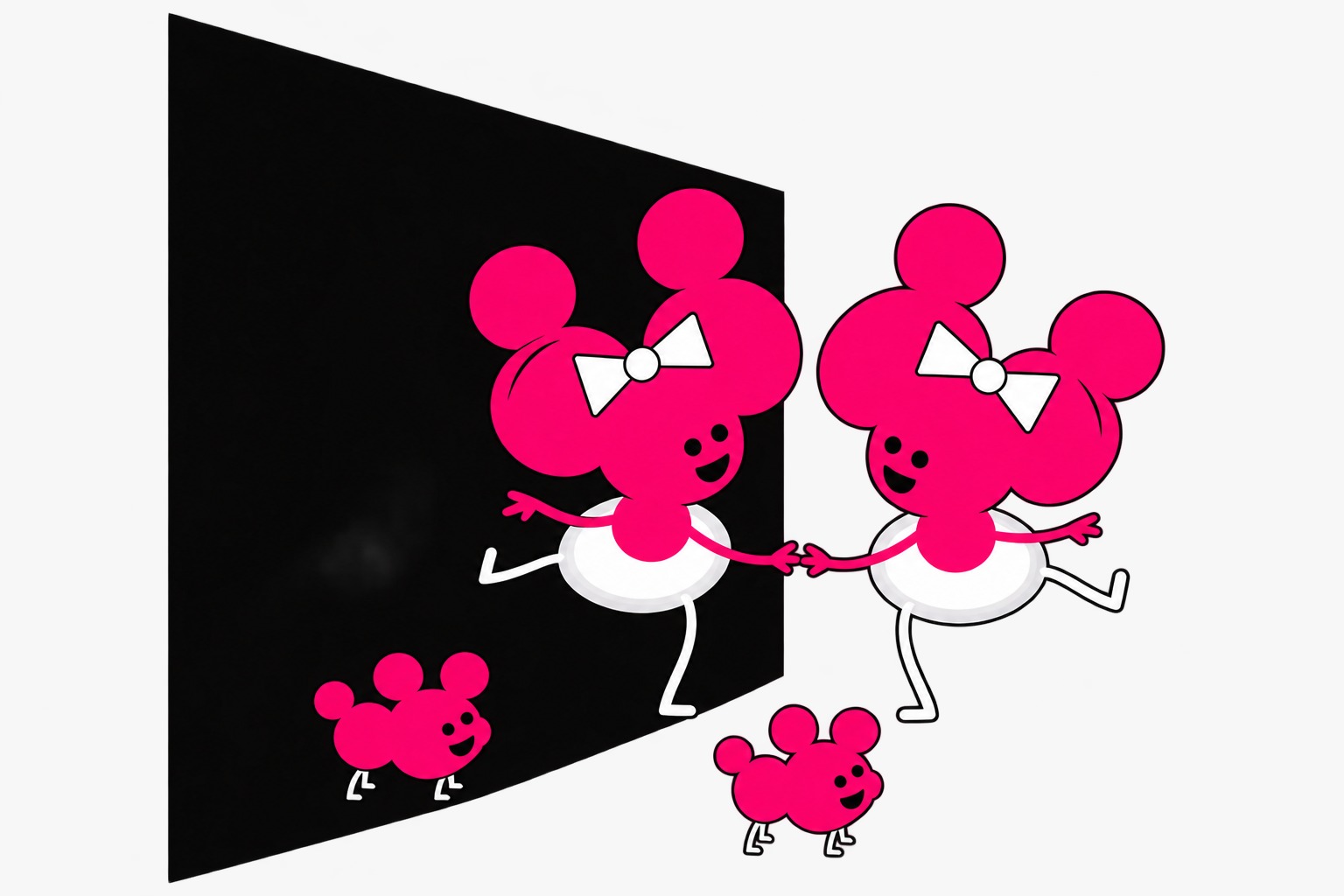
Figure 3. Molecules in the mirror. © Johan Jarnestad/The Royal Swedish Academy of Sciences.

To understand the significance of this discovery, we first need to look at chirality.

A chiral molecule can exist in two forms that are mirror images of one another but cannot be perfectly superimposed. The simplest example is our own hands: the right hand and the left hand are mirror images, but they cannot be placed on top of one another so that they coincide exactly.

In chemistry, these two forms are known as enantiomers.

The phenomenon was first observed in the 19th century, when Louis Pasteur studied tartaric acid and discovered that it could occur in two different crystalline forms that rotated polarized light in opposite directions. This observation paved the way for one of the fundamental concepts of modern chemistry: molecules can have a specific three-dimensional orientation.

The phenomenon became even more significant when scientists discovered that life itself is, to a large extent, homochiral.

Biological systems do not use the two mirror-image forms of a molecule indiscriminately.

For example, the amino acids that make up proteins occur naturally predominantly in one of their two possible configurations. A similar situation occurs with the sugars that form part of DNA. In other words, the chemistry of life has chosen one “hand.”

This raises a fundamental question: how did this asymmetry emerge?

For a long time, chemists observed that when they attempted to synthesize chiral molecules through certain reactions, they generally obtained a mixture of both enantiomers. Yet living organisms predominantly use one of the two forms.

The challenge was therefore not only to understand why this happens in nature, but also to find ways of controlling this asymmetry in the laboratory.

This is particularly important in the pharmaceutical industry. Two enantiomers can interact differently with biological systems: one may produce the desired therapeutic effect, while the other may be less effective or cause unwanted effects. Developing methods that selectively favor the formation of the desired enantiomer is therefore an essential tool in modern chemistry.

01 / Nonlinear Effects

Kagan and Nonlinear Effects: A New Way of Understanding Catalysis

One of the major advances recognized by this year's Nobel Prize came from the work of Henri Kagan.

During the 1970s and 1980s, asymmetric synthesis was developing rapidly. Researchers were looking for catalysts capable of favoring the formation of a particular enantiomer.

The prevailing assumption was that the chirality of the catalyst would be transferred to the product in an approximately proportional manner. However, Kagan began to question this relationship.

His analysis showed that when a catalyst contains different proportions of its enantiomeric forms, the outcome of the reaction does not necessarily follow a linear relationship. Under certain conditions, a small difference in the chiral composition of the catalyst can produce a much larger difference in the chiral composition of the final product.

These phenomena became known as nonlinear effects.

In 1986, Kagan described several reactions displaying this behavior, demonstrating that it was possible to obtain an enantiomeric excess in the product significantly greater than that present in the initial catalytic system.

This discovery changed the way chemists could analyze and design asymmetric reactions. Nonlinearity was no longer simply a chemical curiosity; it became a tool for understanding reaction mechanisms and optimizing selectivity.
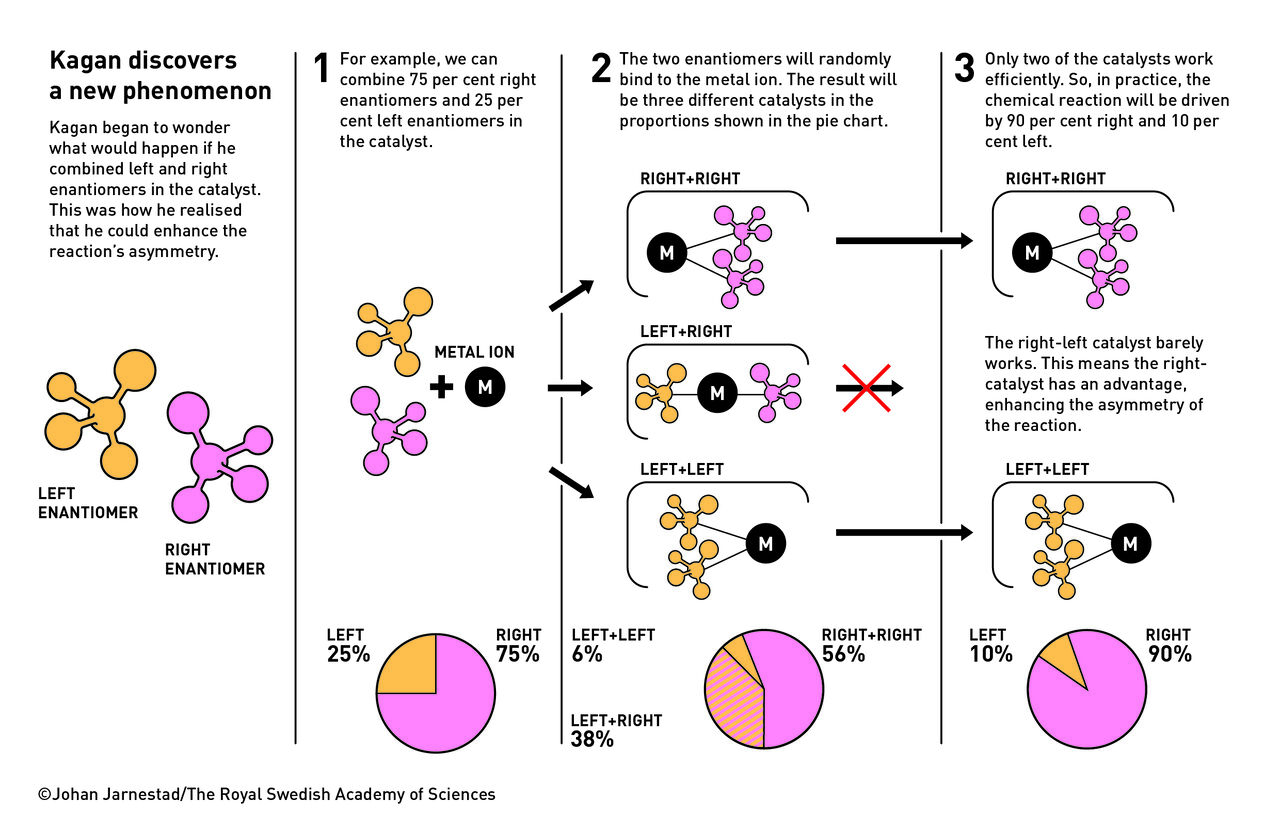
Kagan discovers a new phenomenon: nonlinear effects in asymmetric catalysis
Figure 4. Kagan discovers a new phenomenon. © Johan Jarnestad/The Royal Swedish Academy of Sciences.
02 / Autocatalysis

Soai and the Reaction That Catalyzes Itself

The next step came with Kenso Soai.

Building on the knowledge developed around nonlinear effects, Soai asked whether it might be possible to design a reaction in which the chiral product itself could act as a catalyst for its own formation.

This idea leads to a particularly fascinating concept: autocatalysis.

In an autocatalytic reaction, the product of a reaction participates in the formation of more of the same product. When the process is also asymmetric, a small initial difference between the two enantiomers can progressively amplify.

In 1995, Soai reported a reaction in which a small initial excess of one enantiomer could be significantly amplified. Starting from an enantiomeric excess of just 2%, he obtained an excess of 87%.

But Soai continued working on this approach.

In 2003, he presented an autocatalytic reaction in which one enantiomer could promote the formation of new molecules with the same configuration. The result was an extraordinary amplification of asymmetry: depending on the initial conditions and small random fluctuations, one or the other enantiomer could eventually dominate almost completely.

This reaction, now known as the Soai reaction, became one of the most iconic examples of autocatalysis and an important model for studying the origins of homochirality.
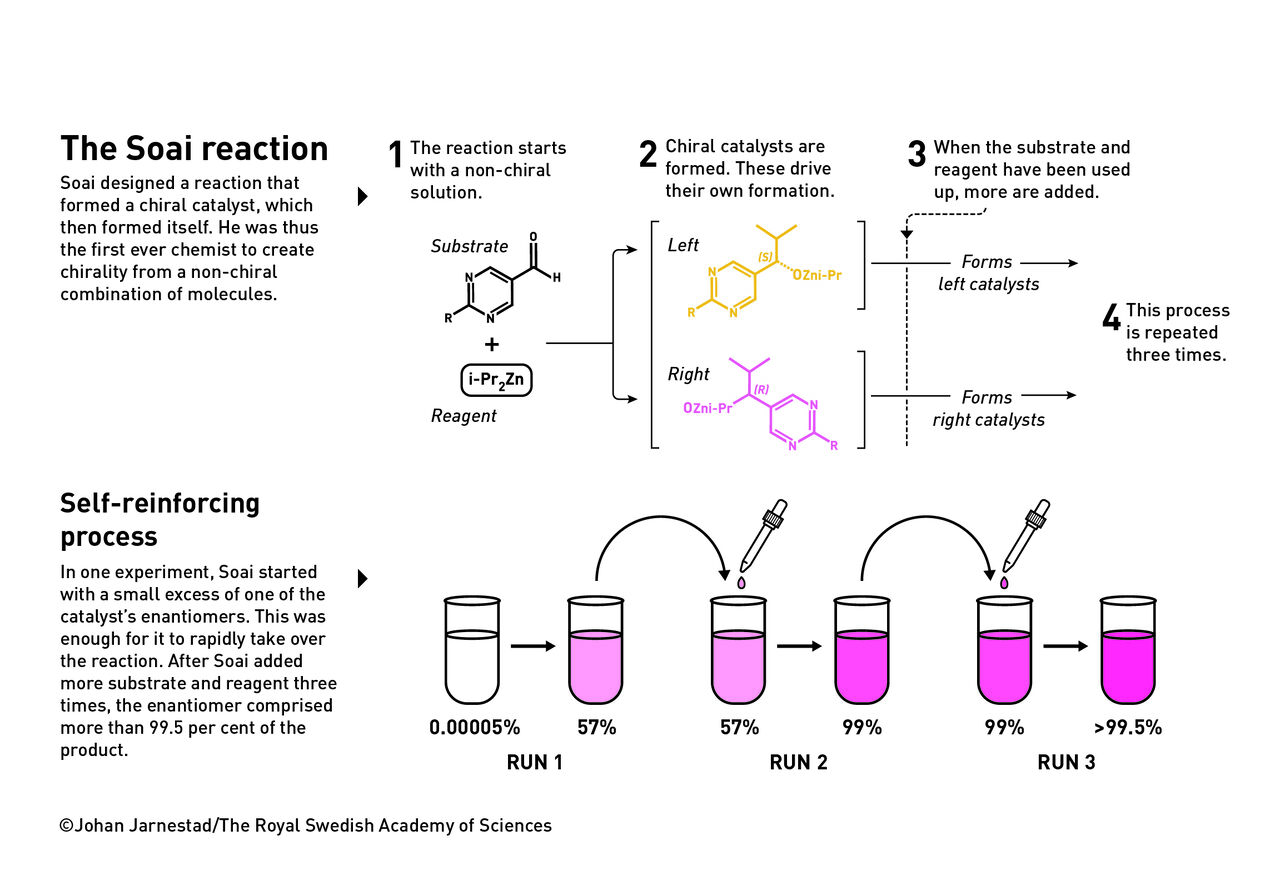
The Soai reaction: asymmetric autocatalysis and amplification of chirality
Figure 5. The Soai reaction. © Johan Jarnestad/The Royal Swedish Academy of Sciences.
From the Mystery of the Origin of Life to Applied Chemistry

The work of Kagan and Soai has a dual significance.

On the one hand, it addresses a fundamental question: how can chemical asymmetry emerge from a system with no clear initial preference?

The Soai reaction does not reproduce the chemistry of life and does not, by itself, provide a definitive explanation for the origin of biological homochirality. However, it provides an extraordinary experimental model for studying how a small initial difference can be amplified into a strong molecular preference.

On the other hand, these discoveries have major practical implications.

The nonlinear effects identified by Kagan have become a valuable tool for understanding and optimizing asymmetric reactions. Controlling the formation of a particular enantiomer is especially important when producing substances intended to interact with living organisms.

As a result, this chemistry has applications in areas such as the pharmaceutical industry, agrochemicals, flavors and fragrances, and the development of new materials.

The 2026 Nobel Prize in Chemistry highlights an idea that lies at the heart of modern chemistry: controlling a reaction is not only about making it happen, but about making it happen in the right way.

Catalysts make it possible to modify the rate and behavior of chemical reactions without being consumed in the process. In asymmetric synthesis, they can also be used to direct a reaction toward a particular molecular configuration.

The work of Kagan and Soai demonstrates how small differences in the structure and behavior of a catalytic system can generate significant consequences in the final product.

This ability to design, control, and optimize chemical processes is one of the foundations for developing new chemical technologies and advanced materials.

From MERYT: Designing Chemistry to Make It Possible

At MERYT Catalysts & Innovation, we understand chemical innovation as the combination of fundamental knowledge, materials design, catalysis, and the transfer of scientific advances into real-world applications.

The 2026 Nobel Prize in Chemistry is an excellent example of how a fundamental scientific question can ultimately transform the way chemists design their processes: from understanding how a particular molecular asymmetry is generated to developing tools capable of selectively controlling a chemical reaction.

The story of Kagan and Soai also reminds us that scientific innovation rarely comes from a single isolated discovery. Knowledge is built progressively: from Pasteur’s early observations of chiral molecules, through the development of asymmetric catalysis, to the nonlinear effects and autocatalysis recognized by this year’s Nobel Prize.

Understanding how chemistry works is the first step toward learning how to control it. And controlling chemistry is essential for transforming scientific knowledge into technological solutions.

From this perspective, the 2026 Nobel Prize in Chemistry not only recognizes a fundamental advance in organic chemistry. It also highlights one of the most important principles of chemical innovation: the precise design of reactions and materials can open new pathways toward more selective, efficient, and industrially applicable processes.

If you would like to learn more about the 2026 Nobel Prize in Chemistry and explore the details of this year’s award, you can visit the official Nobel Prize website. Please find the link below: