Technologies for Mercury Removal
Adsorption is the most effective and widely used technology for mercury removal. The table below compares some of the most commonly used adsorbents in terms of their key features, applications, and adsorption capacity.
Table 1: Comparative Analysis of Mercury Adsorbents
| Adsorbent Type | Key Features | Applications | Operating Conditions | Adsorption Capacity (mg Hg/g) | Cost |
| Activated Carbon (Sulfur Impregnated) | Low cost, effective for elemental mercury (Hg⁰) | Natural gas streams, petrochemical plants | Moderate temperature and pressure | 5–10 | Low |
| Zinc Oxide (ZnO) | High capacity for elemental and organic mercury | Natural gas processing, LNG plants | High temperature stability | 15–20 | Moderate |
| Copper Sulfide (CuS) | Effective for organic mercury removal | Syngas and refinery streams | High temperature, regenerable options | 20–25 | Moderate to High |
| Silver-Impregnated Adsorbents | Exceptional performance at low temperatures | Cryogenic units in LNG plants | Low temperature, high selectivity | 25–35 | High |
Notes:
- Adsorption capacity varies depending on process conditions, such as temperature, gas composition, and mercury speciation.
- Silver-impregnated adsorbents offer the highest capacity but are more expensive, making them ideal for cryogenic applications where low mercury concentrations must be achieved.
Process Design and Optimization
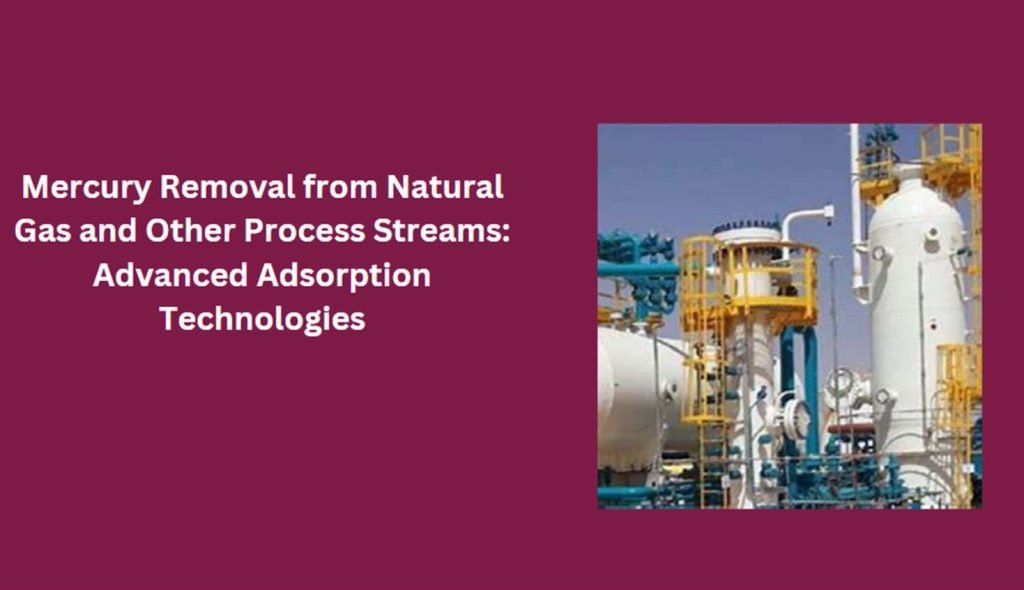
Effective mercury removal requires a comprehensive approach that combines optimal process design, precise control of operating conditions, and careful selection of adsorbents. In Liquefied Natural Gas (LNG) facilities, mercury removal units (MRUs) are strategically placed upstream of cryogenic sections, where mercury levels must be reduced to below 0.01 µg/m³ to prevent amalgam corrosion of aluminum plate-fin heat exchangers.
The MRU typically operates at moderate temperatures (40–80°C) and pressures ranging from 20 to 80 bar, depending on the plant configuration and feed gas composition. Multi-bed adsorption systems are often employed to maximize efficiency and minimize breakthrough risks.
- Primary Bed (Guard Bed): Captures the majority of mercury and extends the life of the main adsorbent bed.
- Secondary Bed: Acts as a polishing unit to ensure mercury concentrations remain within target limits.
- Gas Pretreatment: Removal of water, hydrogen sulfide (H₂S), and other sulfur compounds is critical to protect the adsorbent from fouling and loss of capacity. Moisture content must be reduced to below 1 ppm, as water can significantly reduce adsorption efficiency.
- Real-Time Monitoring: Mercury analyzers with detection limits in the nanogram per cubic meter (ng/m³) range provide continuous measurement of mercury concentrations at both the inlet and outlet of the MRU. Automated control systems adjust flow rates and optimize adsorbent replacement schedules, ensuring consistent performance and minimizing downtime.
Advanced MRU designs also integrate regenerable adsorbent beds for high-capacity operations, reducing long-term operational costs compared to traditional non-regenerable systems.
Future Trends in Mercury Removal
As mercury emission regulations become more stringent, new technologies are emerging to meet these challenges while enhancing efficiency and sustainability. Hybrid adsorbents, combining the properties of metal sulfides and activated carbon, offer higher adsorption capacity and improved thermal stability, making them suitable for a wider range of operating conditions. Regenerable adsorbents, particularly copper-based materials, are increasingly used in high-volume applications due to their cost-effectiveness and reduced environmental footprint.
The adoption of digital process optimization is transforming mercury removal operations. Predictive maintenance algorithms, integrated with process control systems, monitor adsorbent performance in real time and predict breakthrough events before they occur. Machine learning models analyze historical data to optimize regeneration cycles, reduce energy consumption, and extend the life of the adsorbent.
Furthermore, advances in in-situ regeneration technologies are reducing downtime, allowing adsorbent beds to be cleaned and reused without complete shutdowns. Combined with modular MRU designs, these innovations offer increased flexibility for retrofitting existing facilities and scaling up new projects.