The industrial revolution was a time of great change, where new inventions began to shape the world in powerful ways. One of the most important discoveries from that era is the Haber-Bosch process—a method to produce ammonia that has significantly boosted food production and led to many other chemical innovations. At the heart of this process is the catalyst that makes it all work.
The Beginning: A Search for Fertilizer
In the early 20th century, the world faced a big problem: the growing demand for food needed more fertilizer, but natural sources of nitrogen, an essential element for plants, were limited. Nitrogen from the air (N₂) is not usable by plants because it is very stable and doesn’t react easily. Scientists were racing to find a way to convert this nitrogen into a form that plants could use.
Fritz Haber (1868–1934), a German chemist, found the solution in 1909. He developed a method to produce ammonia (NH₃) by combining nitrogen and hydrogen gases under high pressure and heat. However, this reaction was slow and inefficient without a catalyst.
The Catalyst Challenge
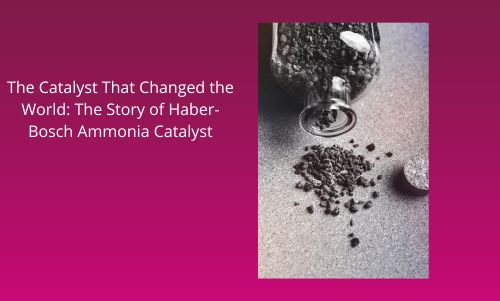
The next big task was to find the right catalyst that could make this reaction fast enough for industrial production. Fritz Haber tried many different materials, but it was Carl Bosch (1874–1940), a chemist at BASF, who figured out how to scale up the process. Bosch discovered that an iron-based catalyst, with small amounts of other elements like potassium and aluminum, worked well under the tough conditions required for the reaction. This breakthrough allowed the Haber-Bosch process to produce ammonia on a large scale, making it possible to meet the world’s growing need for fertilizer.
Why Iron?
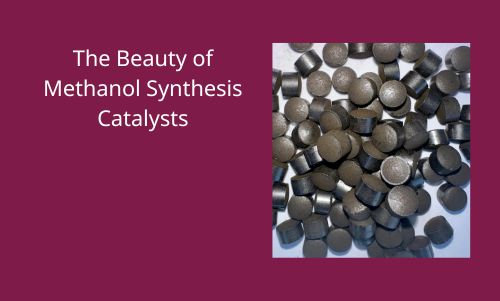
The choice of iron as the main material for the catalyst was crucial. Iron is common, affordable, and has the right properties to break apart nitrogen molecules at high temperatures. The surface of the iron catalyst provides spots where nitrogen and hydrogen atoms can stick, break apart, and then recombine to form ammonia. Potassium helps nitrogen to stick better, while aluminum keeps the catalyst strong and prevents it from clumping together, which would make it less effective.
Changes in Catalyst Composition
Since its initial development, the composition of the Haber-Bosch catalyst has undergone significant changes to improve efficiency and durability. Early catalysts were primarily composed of iron promoted with potassium and aluminium oxides. Over time, researchers have experimented with adding various other promoters, such as calcium and magnesium oxides, to further enhance the catalyst’s performance.
These changes aimed to increase the catalyst’s surface area, improve its stability under high temperatures and pressures, and reduce the energy required for the reaction. Modern catalysts often include rare earth elements, like cerium, which help to prevent the deactivation of the catalyst by impurities, and ruthenium, which has been explored as a more active alternative to iron, though it is more expensive.
Additionally, advancements in nanotechnology have allowed for the creation of catalysts with more precisely controlled structures, maximizing their effectiveness by ensuring more of the catalyst’s surface is active in the reaction. These improvements have made the ammonia production process more energy-efficient and environmentally friendly, though the search for even better catalysts continues.
Impact and Looking Ahead
The success of the Haber-Bosch process changed the world by making nitrogen fertilizers widely available, allowing farmers to produce enough food to feed billions of people. Although over 150 million tons of ammonia are produced annually, the process is energy-intensive and contributes to greenhouse gas emissions. The story of the Haber-Bosch catalyst is one of remarkable achievement, but it also highlights the need for continued innovation. At MERYT, we are dedicated to supporting the future of chemical innovation, offering solutions that meet today’s needs while preparing for tomorrow’s challenges. The Haber-Bosch process and its catalyst may be over 100 years old, but its impact and importance remain strong—driving not just agricultural growth, but the future of sustainable industry.