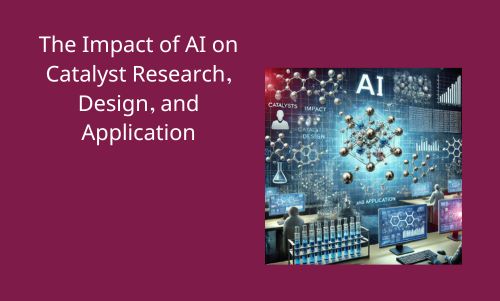
Artificial intelligence (AI) is redefining numerous industries, and its influence on catalysis is set to bring transformative advancements. By enhancing discovery, refining design, and enabling real-time performance optimization, AI is poised to revolutionize how catalysts are developed and used. Here, we explore four significant ways AI is impacting catalyst research and application.
1. Accelerating Catalyst Discovery and Screening
Catalyst discovery has traditionally relied on exhaustive experimental testing, where each variable—composition, structure, and conditions—undergoes iterative fine-tuning. This method, while foundational, is time-consuming and costly. AI, particularly machine learning, is changing this paradigm.
By processing large datasets from past experiments, AI models can predict optimal combinations of materials, structures, and synthesis methods that are most likely to yield effective catalysts. In addition, AI-powered molecular simulations allow researchers to explore reaction mechanisms at an atomic level, uncovering insights that can lead to entirely new catalyst classes. This data-driven approach significantly shortens the discovery timeline and opens up new possibilities for creating innovative catalyst structures.
2. Enhanced Performance and Customization of Catalysts
Catalysts need to be highly selective, stable, and efficient, especially for complex industrial applications. Traditionally, catalyst optimization has been a lengthy process, requiring customization for specific processes and feedstocks. AI-driven insights can streamline and refine this process.
By integrating data on variables such as feedstock composition and operating conditions, AI models can identify precise modifications to catalyst formulations, leading to catalysts with enhanced performance and longevity. This data-driven customization results in catalysts that are better suited to the specific demands of each process, thereby improving selectivity, stability, and efficiency. In turn, this ensures that each catalyst performs at its best, helping industries achieve higher productivity and sustainability.
3. Real-time Process Optimization and Predictive Maintenance
Catalysts often undergo performance changes over time due to exposure to variable temperatures, pressures, and impurities. Traditionally, maintenance schedules have relied on fixed intervals for regeneration or replacement, leading to occasional unplanned downtimes.
AI-enabled monitoring systems, however, offer real-time tracking of catalyst health by continuously analyzing data from operating conditions. Predictive maintenance algorithms can detect signs of deactivation or contamination early, allowing operators to adjust parameters in response. This capability not only extends catalyst life but also prevents unexpected shutdowns, enhancing operational efficiency and reducing maintenance costs. For sectors where continuity is critical, such as refining and petrochemicals, AI-driven predictive maintenance brings substantial value by minimizing downtime and maximizing catalyst utility.
4. Supporting Sustainable Catalyst Development
Sustainability is increasingly central to industrial catalysis, with growing demand for processes that lower energy requirements and minimize environmental impact. AI plays a key role in developing catalysts that support eco-friendly chemical processes, such as CO₂ capture and usage, the conversion of bio-based feedstocks and recycling processes.
By analyzing material properties and performance, AI algorithms can suggest alternative components that meet catalytic requirements while reducing the need for scarce or toxic metals. This capability supports the design of sustainable catalysts that reduce resource dependence and are easier to recycle, aligning industrial catalysis with circular economy principles.
In summary,AI’s role in catalysis represents a profound shift in how catalysts are researched, optimized, and applied. By accelerating discovery, enhancing customization, enabling predictive maintenance, and supporting sustainable development, AI is transforming catalysis into a more efficient, adaptable, and environmentally responsible field. As AI continues to advance, its impact will likely deepen, helping the scientific community and industry meet the evolving challenges of chemical processing with innovative solutions.